Posts

Books: January 2020 Update (Part 1)

Image
Here are some more review from books that I read during the last few months. Sapiens When I make my list of top 10 books that I read in Senegal (which I will do at the end of my service),  Sapiens  will definitely be on it. This was simultaneously the most interesting and least dense history book that I have read in a long time. Harari's writing is straightforward, concise, and easy to process; his subject matter is grand: an overview of human history.  Sapiens  focuses on three major revolutions in human history: the Cognitive Revolution, the Agricultural Revolution, and the Scientific Revolution. Rather than tie a specific event in history to a few events that proceeded it and draw conclusions from that reasoning, Harari's book looks at all of human history with a scope much bigger than a bird's eye view. He covers it all--how Homo sapiens out-competed and/or hunted out all the other species of humans and large mammals; why our language is such a powerf...

December 2019 Pictures

Image
Happy New Year, Travels with Tavish readers! As you have probably noticed, I took a month off from blogging at the start of the new year. I had a busy January which included hosting my dad and cousin Kristi in Senegal, my Mid-Service Conference, and a one-year dental check up (no cavities despite all the attaya). I have had a nice long break away from my village and am feeling ready to face the next hot season when it arrives in March. Starting now I will again be posting on the blog weekly, inchallah. Below are a few pictures from December 2019. Lots more pictures from January will be coming soon. Making soap with a woman in my village. The three ingredients are oil, water, and lye (caustic soda). Stirring the soap. As of mid-January, most of the 20 bars of soap made from this batch had sold. Hopefully there will be some interest among other women in the village to also learn to make soap I left my site on Christmas Eve to come into Kedougou and spend the Ch...

Cashew Training

Image
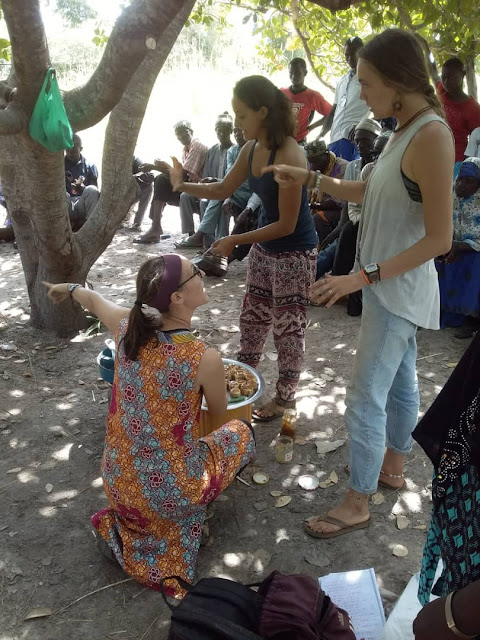
During the end of November and the start of December, a few of us volunteers in Kedougou embarked on a couple trips around the region to do cashew trainings. These three trainings were follow-up for the cashew trainings we conducted in June. With the growing season over, we wanted to gather everyone who planted cashews this year or has existing cashew trees to form a growers' association (or group) in each of the three locations.  The goals of the growers' associations are to make sure people who have cashews know one another so that they can ask questions of one another, get seeds from each other, and eventually (about 5 years in the future when trees start to produce a lot of nuts) sell cashews together. Currently there are no major cashew producers in Kedougou, but a lot of people are starting to plant the trees. The climate in most parts of Kedougou is great for cashew production, so the region has the potential to generate lots of economic activity with cashew sales ...

Diakhanke Greetings and Phrases Part 2

Image
Here are some more greetings and some useful phrases in Diakhanke. If you missed Part 1 of this blog post in November, go back and check that out. I wrote about the importance of greetings and included a few audio files with that post. There are also a couple pronunciation tips in Part 1 of this post. Unfortunately I do not have audio files for these greetings and phrases. If you want the Excel file where I made these tables, let me know and I can email it to you.

Books: October Update (Part 2)

Image
Here is Part 2 of my October book reviews (only two months late). The Fellowship of the Ring : I'm not sure why I put off reading  The Lord of the Rings  so long when I thoroughly enjoyed the movies. Although the action is at times slow, the story was never boring. Tolkein fills the pages with fascinating descriptions of the various lands in Middle Earth and their histories, giving the reader just enough back-story to be curious but never enough to quell the mystery of the historied land. For example, what is a barrow-wight? Where did Tom Bombadil come from and why was he excluded from the movie? What are the details of the dwarves' and elves' long-standing hatred of one another? What surprised me most about  The Fellowship  is that the hobbits don't even reach Rivendell until halfway through the book; it is a while longer still before the council of Elrond is over and the party begins their quest in earnest. It has been a while since I have seen the movi...

November Pictures

Image
Here are some pictures from November: A visit to the area 12km from my village where most people farm their rice. Many residents have built huts near the fields and live here for 3-4 months of the year during plowing, planting, and harvesting times The grassy flat area in the distance is rice  A giant tree in the bush  The view from the top of the hill near the rice fields People from my village cutting rice in their fields My host mom's garden near the river. She transplanted everything from her garden near the forage in village to her sandy garden area next to the river. The river will have enough water to garden until around April My host mom's garden with the river in the background Baobob trees fruiting in my village My other host mom's garden (her friend is pictured) My host mom watering her onions  A cashew tree that my work partner planted. It has been chewed up by animals a little bit (he has not protected i...

Open Field Day

Image
The next week after traipsing to Lombel, I went on a short biking adventure to the Diakhanke (an alternate spelling of Jaxanke, my local language) area of Kedougou. I came into the city of Kedougou from my site (40km), then the next day biked out to a town in the Diakhanke area (61km) to help out with another volunteer's training. The other volunteer was helping her Master Farmer, Dembo Tigana, conduct an Open Field Day. Master Farmers are local farmers who receive funding from Peace Corps to be an agricultural extension agent in their communities. They each have a 1-hectare farm demonstrating agricultural techniques including composting, live fencing, tree nurseries, field crop spacing, and many others. Part of Master Farmers' work includes conducting Open Field Days, large half-day trainings with 50-100 participants, 1-2 times per year. In following with the theme of "things that are not near my village," there is no Master Farmer near my village. (Also included on...